When Sound Was Everything
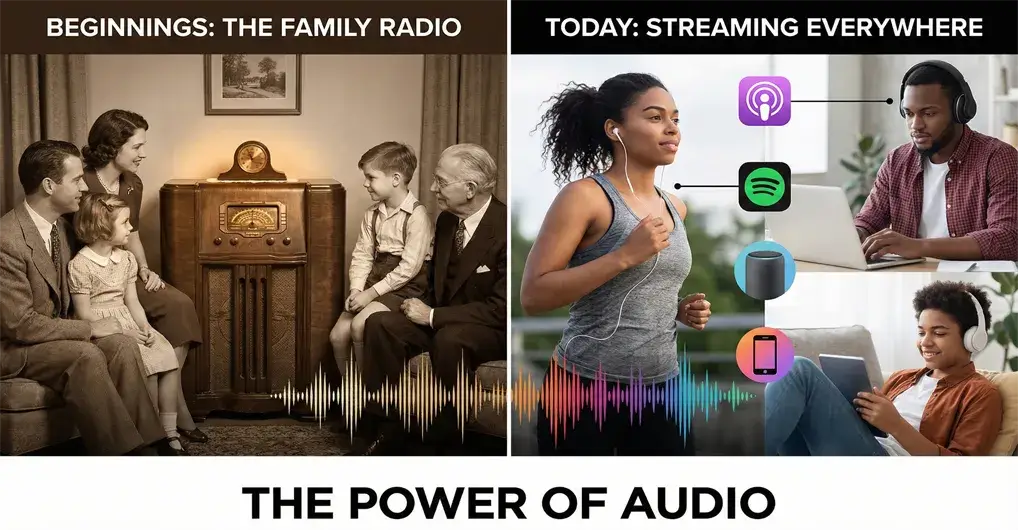
Picture this: It's 1938, and families across America are gathered around their living room radios. No screens, no images—just voices crackling through speakers. When Orson Welles broadcast "War of the Worlds," he didn't need visuals to convince listeners that Martians had invaded New Jersey. The sound of his voice and rudimentary sound effects alone was powerful enough to spark nationwide panic.
That's the power of audio marketing at its purest. Before television, before the internet, before Instagram ads and YouTube pre-rolls, there was radio. And radio proved something fundamental about human psychology: sound creates connection in ways that bypass our rational filters. A voice in your ear feels personal, intimate, like someone's talking directly to you.
The jingles we still remember decades later—"I'd like to teach the world to sing," "Like a good neighbor," "I'm lovin' it!"—these aren't accidents. They're proof that audio etches itself into memory in ways visual advertising often can't match.
The Digital Audio Revolution
Fast forward to today, and audio hasn't lost its power.
Spotify boasts over 600 million users worldwide. iHeartRadio reaches 160 million monthly listeners. Podcast listenership has exploded, with over 460 million podcast listeners globally. But here's what's changed: today's audio marketing isn't just about reach—it's about precision, measurement, and integration.
When I started in radio 20 years ago we used ratings diaries that, at best, gave us a snapshot of a station's audience. But once the advertisers message went out over the airwaves we had no idea if the right ears were listening. Digital audio platforms let us target by demographics, interests, listening habits, time of day, even mood. A fitness brand can reach someone mid-workout. A meal kit service can connect with listeners during their evening commute—right when they're wondering what's for dinner. A B2B software company can sponsor a business podcast where their exact target audience is actively engaged and receptive.
The intimacy that made radio powerful? It's amplified in the streaming era. People listen to Spotify while working out, commuting, cooking, winding down before bed. These are personal moments. When your brand shows up with the right message at the right time, you're not interrupting—you're becoming part of their routine.
Why Multi-Sensory Marketing Matters More Than Ever
Here's the reality of digital marketing in 2025: we're drowning in visual content. The average person scrolls past hundreds of images and videos daily. Banner blindness is real. Ad fatigue is real. Visual overload is real.
Try this. Scroll through Instagram with no sound, try it for a couple minutes then swipe the scroll down back to where started but with the sound on and notice the difference in your sensory experience. That's an example of the power of sound. This is precisely why smart marketers are rediscovering the power of engaging multiple senses—especially sound.
Think about your customer's day. They're staring at screens constantly: checking emails, scrolling social media, attending Zoom meetings, watching Netflix. Their eyes are exhausted. But their ears? Their ears are available. They're listening while driving, exercising, doing household chores, even while working.
Audio reaches people in moments when visual marketing can't. It's the ultimate lean-back medium—your audience doesn't need to stop what they're doing to absorb your message. And because they're often doing something routine or relaxing while listening, they're in a receptive state of mind.
The most sophisticated digital campaigns don't just pile on more visual content. They orchestrate experiences across multiple touchpoints and senses:
- A customer hears your podcast ad during their morning run
- Later, they see your Instagram post and recognize the brand
- Your email arrives with messaging that echoes the audio
- They visit your website and hear a sonic logo that ties it all together
Each touchpoint reinforces the others. The audio component doesn't compete with visual marketing—it completes it.
Practical Applications for Your Brand
So how do you harness audio in your digital marketing strategy? Here are the channels that are delivering real results:
Streaming Audio Ads: Platforms like Spotify, Pandora, and iHeartRadio offer targeted advertising that reaches listeners during highly engaged moments. These aren't skippable like many video ads, and they benefit from the "theater of the mind"—listeners visualize your message in their own way.
Podcast Sponsorships: With over two million active podcasts, there's a show for every niche audience imaginable. Podcast listeners are loyal, engaged, and trust their hosts. A host-read ad feels like a recommendation from a friend, not a commercial interruption.
Sonic Branding: Your logo has a look. Should it have a sound? Intel's five-note mnemonic is recognized worldwide. McDonald's "I'm lovin' it" jingle transcends language. A well-crafted audio signature makes your brand instantly recognizable across platforms.
Voice Search Optimization: With smart speakers in millions of homes, optimizing for voice search isn't optional—it's essential. How people speak differs from how they type. "What's the best pizza near me" becomes "Hey Siri, where should I order pizza from tonight?"
Audio Social Content: Instagram Stories, TikTok, and Reels all prioritize sound-on content. The right music choice or voiceover can dramatically increase engagement and shareability.
Interactive Voice Ads: Some platforms now offer voice-activated ads where listeners can speak commands to learn more or make purchases—turning passive listening into active engagement.
The Neuroscience Behind the Sound
Why does audio marketing work so effectively? Neuroscience offers some answers.
Music and sound trigger emotional responses faster than visual stimuli. They activate the limbic system—the emotional center of the brain—directly. A song can transport you back to a specific moment in your life instantaneously. A familiar voice can create feelings of trust and comfort.
Audio also benefits from what researchers call the "cocktail party effect"—our brain's ability to focus on a single sound source in a noisy environment. When someone's wearing headphones, your message isn't competing with visual clutter. It has their full auditory attention.
And here's something fascinating: people process audio content while multitasking more effectively than visual content. You can fully absorb a podcast while cooking dinner, but try reading an article while chopping vegetables. Audio fits into life in ways visual content simply can't.
Learning from Radio's Golden Age
The marketers who created radio's golden age understood something we're rediscovering today: great audio marketing isn't just about being heard—it's about being memorable, engaging, and authentic.
Radio shows built loyal audiences by delivering consistent value and entertainment. Today's successful podcast sponsors do the same—they support content their audience loves, and that goodwill transfers to the brand.
Radio jingles were crafted with the same care as hit songs because marketers knew listeners would hear them hundreds of times. Today's sonic branding requires the same thoughtfulness—it needs to be distinctive without being annoying, memorable without being grating.
Radio's most effective ads told stories. They created characters, scenarios, and emotional arcs in 30 or 60 seconds. The same principles apply to streaming audio ads today. The brands that succeed aren't just listing features—they're creating mini-narratives that resonate.
The Future Sounds Good
As we look ahead, audio marketing's role will only grow. Smart speakers are becoming household staples. Audio-first social platforms are emerging. Virtual and augmented reality experiences rely heavily on spatial audio. In-car entertainment systems are becoming more sophisticated, creating new opportunities for contextual audio marketing.
The brands that win won't be the ones that simply port their visual marketing strategies to audio platforms. They'll be the ones that understand audio's unique strengths—its intimacy, its ability to reach people in otherwise unreachable moments, its power to create emotional connections through voice, music, and sound.
They'll be the brands that think in surround sound, not just in pixels and posts.
Time to Turn Up the Volume
Digital marketing has never been just about digital. It's about reaching real people in real moments with messages that resonate. Sometimes that means a striking visual. Sometimes it means a compelling video. And increasingly, it means a voice in someone's ear at exactly the right time.
Radio taught us that sound alone could build brands, drive sales, and create cultural moments. Digital audio platforms have given us the tools to do all that with unprecedented targeting, measurement, and integration with other channels.
The question isn't whether audio should be part of your digital marketing strategy. The question is: what's your brand going to sound like?
Ready to amplify your digital marketing strategy with audio? Let's talk about creating multi-sensory campaigns that reach your audience wherever they are—and in whatever moment they're ready to listen.